
The Asset Nobody Lists: Why Company Data Is Worth Money in Bankruptcy
Most schedules I've seen list the obvious things. Equipment, vehicles, receivables, maybe a trademark. What rarely shows up is the data the business built over years of operating: customer records, transaction histories, product catalogs, support logs, content archives, and the software that holds it all together.
That gap matters. If the data has value, it's an estate asset. And if nobody lists it, nobody sells it.
Data is property of the estate
Section 541 is broad on purpose. The estate includes "all legal or equitable interests of the debtor in property as of the commencement of the case" (11 U.S.C. § 541(a)(1)). Nothing in that language carves out databases, digital records, or the rights a business holds in the information it collected.
So the first question isn't whether data counts. It's whether this debtor's data has an owner, a buyer, and a lawful path to a sale.
Why it goes unscheduled

Debtors have to file a schedule of assets and liabilities (11 U.S.C. § 521(a)(1)). In practice, data tends to slip through for plain reasons:
- Owners don't think of it as something they "own." It lives in a CRM or a cloud account, not on a balance sheet.
- It often has no book value, so the accountant never flagged it.
- The people who know where it lives, like a former IT contractor or an ops manager, are gone by the petition date.
None of this means anyone is hiding anything. It just means the asset is easy to miss, and a case that looks like a no-asset case on paper may not be one.
What the trustee's job points to
A Chapter 7 trustee's duty is to "collect and reduce to money the property of the estate" (11 U.S.C. § 704(a)(1)). Data that can lawfully be sold is property that can be reduced to money.
A few practical questions help surface it early:
- What systems did the business run on, and who holds the admin logins now?
- Are the cloud and SaaS accounts still active, or about to lapse for nonpayment?
- What did the company collect, from whom, and under what terms of service or privacy policy?
- Is there proprietary content, code, or a dataset that someone outside the company would want?
Access is often the urgent part. An account that gets shut off for an unpaid bill can take the asset with it.
And if a case has already closed, it can be reopened "to administer assets" (11 U.S.C. § 350(b)).
Selling it under Section 363
Once you've identified the data, the sale runs through the familiar process: a sale outside the ordinary course of business, after notice and a hearing, with court approval (11 U.S.C. § 363(b)).
Not all data is the same, though. Business records, product data, and non-personal datasets usually raise fewer issues. Customer data about individuals is where the Code adds guardrails.
The privacy rules for customer data
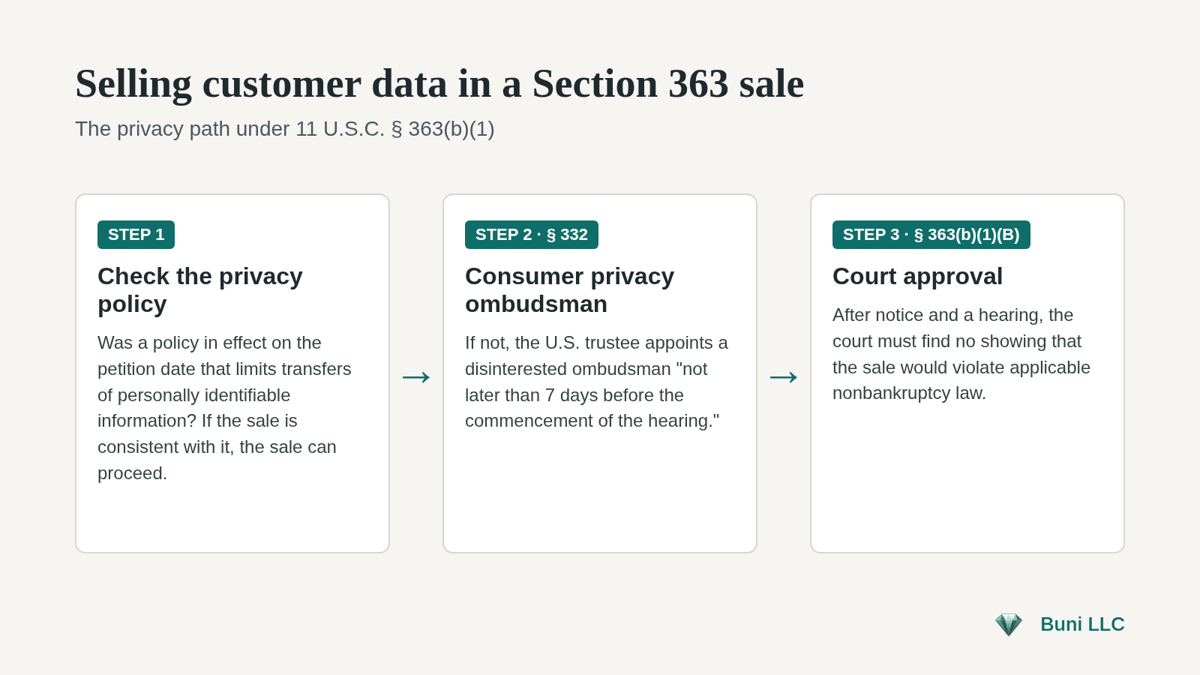
Congress addressed this directly. If the debtor had a privacy policy in effect on the petition date that barred transferring personally identifiable information to unaffiliated parties, the trustee can't sell or lease that information unless one of two things is true (11 U.S.C. § 363(b)(1)):
- the sale is consistent with that policy, or
- a consumer privacy ombudsman is appointed under section 332, and after notice and a hearing, the court approves the sale, giving due consideration to the facts, circumstances, and conditions, and finding no showing that it would violate applicable nonbankruptcy law.
"Personally identifiable information" is a defined term. It covers items like an individual's name, address, email, phone number, and financial account numbers, when provided to the debtor in connection with getting a product or service primarily for personal, family, or household purposes (11 U.S.C. § 101(41A)).
When a hearing is required, the court orders the United States trustee to appoint a disinterested person to serve as the ombudsman, at least 7 days before the hearing (11 U.S.C. § 332(a)). The ombudsman can appear and give the court information about the proposed sale, including the debtor's privacy policy and the potential harms or benefits to consumers (11 U.S.C. § 332(b)). The U.S. Trustee Program handles those appointments.
In short, customer data can be sold, but the privacy policy, the ombudsman, and the court all have a say. Building that into the timeline from day one beats discovering it at the sale hearing.
Where a broker fits
Most trustees don't have a buyer list for datasets, and most debtors' data needs some work before anyone can evaluate it. That's the gap Buni LLC works in. We don't take custody of the data or hold it. We help identify what might be sellable, connect the estate with appropriate buyers, and refer out the technical and legal pieces to the right people, so the trustee and counsel stay in control and the court process runs the way it normally would.
A practical starting point
If you're looking at a file right now, a short checklist:
- Ask the debtor what systems and accounts the business used.
- Secure access before accounts lapse.
- Pull the privacy policy that was in effect on the petition date.
- Separate personal customer data from everything else.
- Plan for an ombudsman if 363(b)(1) applies.
If you have a case where this might apply, or you're just not sure whether it does, I'm happy to talk it through. Grab 20 minutes on my calendar. No pitch, just a look at whether there's something there.
Amy Sullivan, Buni LLC
This article is general information, not legal advice.